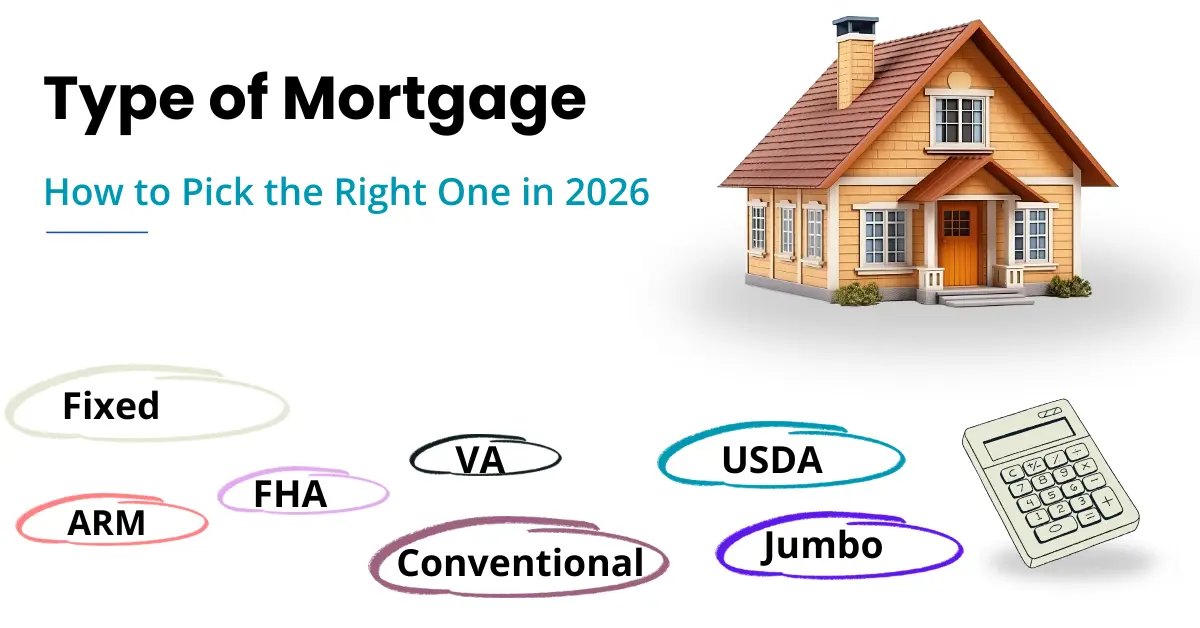
Most people spend weeks choosing a house and about ten minutes choosing a loan. That’s backwards. The type of mortgage you pick decides your monthly payment, how much cash you need upfront and how much interest you pay over the next 30 years.
So let’s slow down and go through your options in plain English.
Start here: fixed-rate or adjustable
Fixed-rate mortgage. Your interest rate never changes. Your principal and interest payment stays the same until the loan is paid off. It’s the most popular type of mortgage because it’s easy to plan around. The catch is that the starting rate is often a bit higher than an adjustable loan.
Adjustable-rate mortgage (ARM). The rate stays fixed for a set period, usually 5, 7 or 10 years. After that it adjusts with the market. A 5/1 ARM is fixed for five years and then changes once a year. This type of mortgage can work well if you plan to sell or refinance before the rate resets. It gets risky if you’re not sure you will.
Loan programs and who they fit
Conventional loan. Not backed by the government. Some programs let you put down just 3%. If you put down less than 20% you’ll pay private mortgage insurance (PMI) until you build enough equity. With solid credit this is usually the default type of mortgage for a buyer. It often comes with the best rates too.
FHA loan. Backed by the Federal Housing Administration. You need a 580 credit score for 3.5% down. A score between 500 and 579 means 10% down. Every FHA loan carries mortgage insurance. If you put down less than 10% it lasts for the life of the loan unless you refinance.
VA loan. For veterans, active-duty service members and some surviving spouses. Many borrowers put nothing down and pay no monthly mortgage insurance. If you qualify it’s often the cheapest type of mortgage out there. There is a one-time funding fee, though some borrowers are exempt.
USDA loan. For eligible rural and some suburban areas. No down payment is needed but there are income limits.
Jumbo loan. For amounts above the conforming limit. In 2026 that limit is $832,750 in most counties and up to $1,249,125 in high-cost areas. Lenders usually want a credit score in the 700s and at least 10% down.
Don't forget the loan length
A 30-year loan gives you a lower monthly payment. A 15-year loan costs more each month but saves you a huge amount of interest. Run both numbers before you decide.
Which one fits you?
- Small down payment and lower credit score: look at FHA first
- Strong credit and 5% to 20% down: conventional is usually the best fit
- Military service: check VA before anything else
- Rural home and modest income: see if USDA applies
- Expensive market: you may need a jumbo loan
Choosing the right type of mortgage also means looking past the rate. Ask about mortgage insurance and closing costs. Those can change the real price of a loan more than a quarter-point in rate.
Mistakes to avoid
Don’t compare lenders on rate alone. Don’t forget that FHA insurance can stick around for decades. Don’t apply with only one lender. Get at least three Loan Estimates and compare them line by line.
The bottom line
There’s no single type of mortgage that wins for everyone. Compare each type of mortgage side by side using your own credit score, savings and plans. The best type of mortgage is the one you can afford comfortably even when life gets expensive.
This post is for general information and isn’t financial advice. Talk to a licensed lender about your situation.